
“What can I say – we have worked alongside colleagues at Interface since 2019 with over 20 different projects under our belt. Each project has sharpened and nudged us forward. This genuine relationship has also led to a long‑term partnership with UWS and connections with multiple universities. From immersive tech to engineering, sustainability and now social robotics, Interface has helped us open ourselves up to fresh, innovative thinking with real impact. It’s a win‑win‑win.”
Mike Benson, Director, The Scottish Crannog Centre
Background
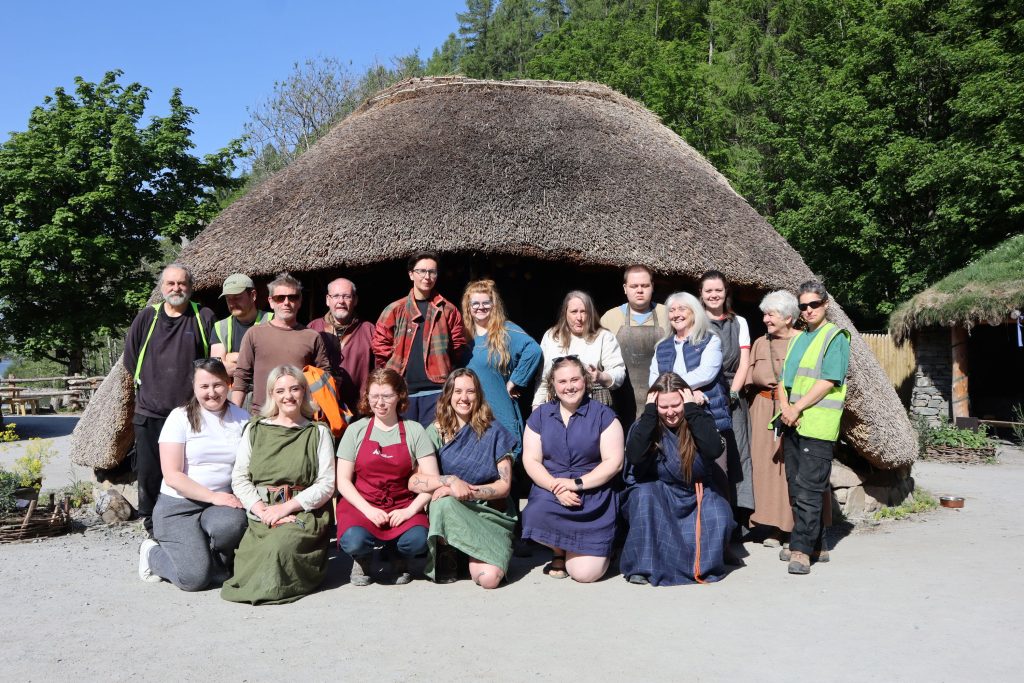
The Scottish Crannog Centre, located on Loch Tay in Perthshire, is an award‑winning museum and living history site dedicated to caring for, researching and sharing the stories of Scotland’s Iron Age crannogs. Through reconstructed dwellings, experimental archaeology, traditional crafts and immersive interpretation, the Centre brings to life how people lived, built and engineered over water some 2,500 years ago.
Since the original Interface‑supported project, the organisation has undergone a period of profound change. Following the devastating fire in 2021, the Centre relocated to a larger, better‑situated site at Dalerb on Loch Tay. This move accelerated its transformation from a successful but ageing visitor attraction into a values‑driven, museum‑focused organisation with social justice, sustainability and community at its heart. The Centre has since more than tripled its income, doubled staff numbers and embarked on a £6m redevelopment programme, including the construction of a new, full‑scale crannog using predominantly Iron Age techniques and materials.
All of this growth has been underpinned by long‑term collaboration with universities across Scotland, brokered and supported by Interface.
The Challenge
As the Centre evolved, it faced multiple, interconnected challenges:
- Modernising interpretation and exhibitions while retaining the authenticity and emotional power of hands‑on, outdoor heritage.
- Demonstrating the sophisticated engineering, sustainability and ingenuity of Iron Age building techniques in ways that are accessible to diverse audiences.
- Embedding social impact, community participation and sustainability into the DNA of a new national museum.
- Rebuilding resilience, capacity and confidence following the loss of the original crannog.
Meeting these challenges required specialist academic expertise, fresh perspectives and the capacity to experiment – resources that are difficult for a small cultural charity to access alone.
The Journey and Interface’s Role
Interface has played a sustained, strategic role since 2019, acting as a trusted connector between the Scottish Crannog Centre and academic expertise. Innovation Engagement Executive Lorna Watson worked closely with Director Mike Benson and the wider team to understand evolving ambitions and identify the right academic partners at each stage of development.
Rather than a single intervention, Interface enabled a portfolio of collaborations that grew alongside the organisation, spanning technology, engineering, design, sustainability, social impact, marketing and robotics. Over 20 projects have now been delivered, many supported by Scottish Funding Council Innovation Vouchers and follow‑on funding.
Key Collaborations and Developments
Immersive Technology and Interpretation (University of the West of Scotland)
The original Innovation Voucher project with UWS laid the foundations for a step‑change in interpretation. It delivered:
- A feasibility study for immersive and mixed‑reality heritage experiences.
- Designs for augmented exhibition spaces.
- Prototype VR and mobile‑based experiences.
These outputs informed the creation of a new gallery and continue to shape the Centre’s approach to storytelling, helping collections to “sing” to different audiences. The partnership has since expanded to include branding, marketing, student placements, VR development and sustainability‑focused projects, forming a long‑term strategic relationship.
Artefacts, Design and Creative Media (UWS & UHI)
Follow‑on projects that brought unseen artefacts to life and enhanced The Crannog brand include:
- A 3D printed replica of a rare Iron Age musical instrument bridge that visitors can handle.
- A student‑designed comic book aimed at educating children on Iron Age Scotland, the artefacts found on the excavation site and how they relate to life in 500BC. An authentic and meaningful project, the comic book is still sold in the centre today and the storyline drives the puppet show delivered to families throughout the season offering a great way to engage with younger audiences.
- An important piece of work involved the rebranding of The Crannog prior to the launch of the new site in 2025 following a £6 million development. Ewan Smith, a design student with UHI Perth developed the branding, delivered workshops to staff and volunteers, tested and honed the design coming up with the complete branding both physical and online for the opening of the new site at Dalerb.
Engineering the Iron Age (Heriot‑Watt University)
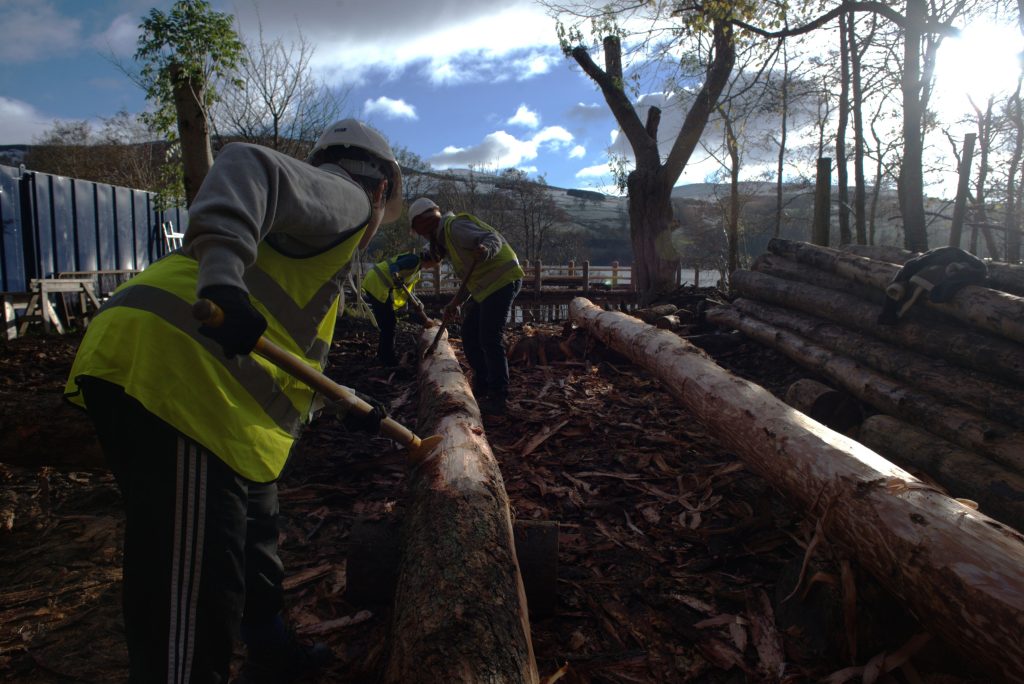
As part of the move to Dalerb, Interface connected the Centre with Heriot‑Watt University engineering students to explore the structural ingenuity of crannog construction. Working alongside craftspeople, archaeologists and engineers, students designed interactive model crannogs made from sustainable materials reclaimed from the main build.
These hands‑on models, launched in spring 2025, allow visitors to experiment with forces, stability and construction strategies, translating Iron Age engineering into playful, contemporary learning. For students, the collaboration reframed engineering beyond industrial contexts, highlighting sustainability, logic and longevity.
Measuring Social Impact and Sustainability (University of Glasgow)
A 2023/24 student placement focused on articulating the Centre’s societal impact. This work examined:
- Mentoring and work experience for local young people with additional support needs.
- Partnerships with organisations such as Glasgow Association for Mental Health, Maryhill Integration Network and UNESCO Refugee Integration through Languages and the Arts.
- The Centre’s four pillars of sustainability: people, partnerships, place and landscape.
The project helped evidence a sustainable museum model based on growing materials, skills, partners and audiences, supporting award submissions and future funding.
Film, Storytelling and the Rebuild (Edinburgh Napier University)
A filming placement documented the reconstruction of the new crannog, capturing traditional skills, community participation and the ambition to create a national museum with activism and inclusion at its core. This content supports interpretation, fundraising and digital engagement.
Looking Ahead: Social Robotics (University of Glasgow, 2026)
The next phase of innovation will explore human‑centred social robotics. In a co‑design research partnership, researchers will work with staff and visitors to prototype robots that enhance public engagement, for example, supporting tours or multilingual interpretation while reflecting the Centre’s values of inclusivity and care.
Impacts on the Organisation and Community
Organisational Growth and Resilience
- More than tripled income and doubled staff since relocation.
- Strengthened brand identity and national profile.
- Increased capacity to attract funding and deliver complex capital projects.
Innovation and Visitor Experience
- New galleries, interactive models, VR and tactile exhibits.
- Interpretation that connects ancient engineering, sustainability and contemporary challenges.
Community and Social Impact
- Deepened engagement with local communities, refugees, mental health organisations and young people with additional support needs.
- A co‑created museum shaped by “a thousand fingerprints and voices”.
Skills, Learning and Talent Pipeline
- Real‑world learning opportunities for students across engineering, design, media, computing and social sciences.
- A two‑way exchange where academic insight and lived heritage practice inform one another.
Academic Benefits
Academic partners have gained access to a rich, real‑world testbed for applied research and teaching. Students engage with authentic challenges, while universities strengthen their civic mission and visibility. Relationships have extended into advisory roles, placements, curriculum enrichment and long‑term research collaborations.
Moving Forward
The Scottish Crannog Centre demonstrates how sustained academic collaboration – enabled by Interface – can transform a small heritage organisation into a resilient, innovative, community‑centred national museum. Geography has proven no barrier to excellence; instead, partnership, curiosity and shared values have driven growth, impact and ambition far beyond the loch shore.
The Data Analytics Conference & Sandpit taking place at UHI Inverness on 25th August will provide an opportunity for students and academics from across Scotland to showcase their research, and for industry professionals to collaborate with academic experts to design innovative solutions for data problems in their businesses.
The programme will consist of in-person talks, poster presentations and sandpit sessions.
For students and academics
If you are a researcher based in Scotland and are interested in presenting your work through a poster presentation, please submit your details.
For businesses, industry and third sector professionals
If you have a business problem that requires a data-solution but you aren’t quite sure where to start, we would love to invite to you participate in a sandpit session. Please see the Sandpit overview, submit your details and we will contact you about next steps.
Organisers
The event is being organised by Dr Andrew Duncan at University of Highlands and Islands with support from SICSA.
Women leading innovation in agriculture and aquaculture.
This webinar by Highlands and Islands Enterprise will showcase inspiring stories from female leaders in agriculture and aquaculture. Find out more about what innovation means and what support is available to female led agriculture and aquaculture businesses across the Highlands and Islands.
You will also have the opportunity to connect to a like-minded community and find out about future innovation events.
Join Visit Moray Speyside for the first collaboration event with Moray Climate Action Network [Moray CAN] to hear from speakers about sustainable tourism.
This event aims to highlight the significance of sustainable tourism practices, shedding light on how collective efforts can contribute to preserving the beauty of Moray.
The event will feature The Cabrach Trust, Duffus Estate, Threaplands Garden Centre, InKeith and Strathisla and WDC Scottish Dolphin Centre who are all dedicated to being a sustainable business/organisation. Don’t miss this opportunity to be part of the conversation and learn how you can contribute to responsible tourism while enjoying the best that Moray has to offer.
The DHI Rural Centre of Excellence project in Moray is supporting the delivery of additional educational opportunities, courses, and skills provision – both for people interested in a career in digital health and care and for current and future frontline health and care staff in need of understanding digital ways of working. We also want to raise awareness about the types of jobs, career opportunities, and skills requirements associated with digital health and care.
Digital technology is transforming the health and care sector. This will affect the way health and social care is delivered in Moray and will have an impact on the skills and capabilities required by the workforce.
The event is free to attend, and you can expect to:
- Learn more about digital health and care developments in Moray – and broader Scotland-wide challenges and opportunities.
- Hear from local and national employers about the digital skills and competencies that health and care employers need.
- Learn how digital technology can support people with their health and wellbeing needs.
- Discover more about DHI’s current projects, and the skills-related research we have been carrying out over the last few years.
- Hear an update on new online courses supporting the adult social care workforce in Moray.
- Share best practices and understand how digital health & care stakeholders can learn from one another, work together and partner with local and national agencies.
SPEAKERS
Simon Bokor-Ingram, Chief Officer, Health and Social Care Moray
Janette Hughes, Director of Planning and Performance, Digital Health & Care Innovation Centre (DHI)
Sanna Rimpiläinen, Head of Research and Skills, Digital Health & Care Innovation Centre (DHI)
Rosemary McCormack, Head of Curriculum, UHI Moray
Dylan White, Principal Lead, NHS Youth Academy
Ruth Cochrane, Lead Academic, Glasgow School of Art Innovation School
Andrew Ord, Account Executive, Microsoft
There will also be representatives from NHS Grampian, Scottish Care, the Cognitive Assistive Robotic Environments (CARE) Group at Heriot-Watt University, Scottish AI Alliance, Skills Development Scotland, Education Scotland, and the Scottish Ambulance Service.
The Get Set Yeti app is in development, themed around a clan of yeti characters, that allows younger children to understand their emotions, through discovering ‘emotion beasties’, enabling difficult concepts to be put across in an age accessible and engaging way.
Background
Get Set Yeti is a Digital Education business, that specialises in using storytelling and character-based learning to make Growth Mindset accessible to younger children at school and at home. They aim to level the ‘educational playing field’ by helping children from all walks of life develop the skills to become confident, resilient learners. They also provide materials for parents to build their confidence and capacity to do the things at home that have an impact on creating solid school foundations in Early Literacy and Early Numeracy.
Get Set Yeti supports educators and parents to help children develop learning resilience and confidence through building a growth mindset, and through emotional literacy. They offer a range of programmes and resources themed around a clan of yeti characters.
The company came into existence through recognition of a need in the field and has been developed by its founder Carol Arnott. An experienced practitioner both in Primary and Community Education, Carol employed Growth Mindset techniques initially to develop a rhyming story to help local families struggling with learning confidence. The story of “The Yeti’s Roar” was born, developed into a book which grew into a learning programme that was successfully trialled in several local schools and nurseries in the Dundee area.
Developing the programme became a passion of Carol’s and with the help of Business Gateway and the Elevator Business Accelerator, where Carol was introduced to Interface, her business began and demand quickly developed to the stage of looking to grow the team and expand into other cities – then Covid hit. Unable to get into schools due to closures and distancing regulations and with other contracts put on hold it became apparent that digital learning was the way forward. A new site was built and ‘Get Set Yeti’ evolved and grew.
The Challenge
Get Set Yeti was created to provide Growth Mindset resources for children under 8 due to the lack of material available. In the educational climate, there was a growing need for children to learn to be more resilient in learning and it was widely recognised that learning to develop a ‘Growth Mindset’ could successfully meet this need.
Get Set Yeti was interested in developing an app or platform that could help young children understand and process emotions using Growth Mindset to help maintain positive mental health.
The Solution
Through the Accelerator in Dundee, Carol met Lorna Watson of Interface who identified University of Dundee’s Dr Michael Crabb (School of Science and Engineering) and Dr Alexia Barrable (School of Education and Social Work) who had the required academic expertise to develop an app that could help younger children develop emotional literacy and self-regulation. This initial project was taken forward with a £5000 Standard Innovation Voucher.
The team at the University of Dundee helped initialise ‘The Yeti Field Guide to Feelings’ app to help children develop emotional literacy, supported by parents and educators.
Based on the premise that deep in the forest on top of Yeti Mountain the yetis sometimes come across ‘Emotion Beasties’ that have escaped from children in the villages below. Once caught, the yetis learn how to look after them using their special book ‘The Yeti Field Guide to Feelings’. They learn that caring for feelings takes practise and learn techniques to manage them through online interaction and additional printable activities and resources.
The app will incorporate:
- Simple gameplay to capture the engagement of the user.
- Diagnostic tool Information on emotions.
- A range of resources and tools to reinforce and support, designed by appropriate mental health experts.
This innovation sits right at the heart of Get Set Yeti’s core strategy as it uses process design to help children and families understand difficult concepts and gives them the tools to develop skills to learn successfully using Growth Mindset techniques.
The Benefits
- Get Set Yeti created a collaborative co-design programme for children and are in the process of securing funding to create the app with all the necessary building blocks in place.
- Get Set Yeti have developed an ongoing partnership with the University of Dundee and are able to provide opportunities for current students and graduates.
- Further opportunities to connect to the School of Education, CLD and Social Work during the testing phase of the app, along with the Department of Science and Engineering.
The Next Steps
Get Set Yeti have transitioned through the restrictions brought about by Covid19, transforming from a localised, face-to-face delivery company to an online-learning portal with international potential.
Following on from this initial project the relationship between Interface and Get Set Yeti has continued to grow and there have been several more successful student projects/placements for a range of things from marketing to behavioural analysis as follows:
Due the restrictions brought about through Covid19 Get Set Yeti pivoted to produce a digital version of their material and with the help of Abertay University the company developed a digital marketing strategy to promote their digital offering and transform from a localised business to offer their products nationally and develop a marketing campaign to appeal to local authorities, head teachers, infant teachers and parents.
A successful student placement project with the University of West of Scotland helped Get Set Yeti achieve a targeted marketing campaign appealing to potential clients and partners; utilising social media and other appropriate available channels.
The University of Stirling undertook some behavioural analysis to help Get Set Yeti understand and develop customer personas to allow them to enter new markets and target their future campaigns for maximum impact.
University of Highlands and Islands students are currently working directly with the Musical Director and CEO to help devise a digital marketing and social media campaign to promote an album of original ‘Yeti Songs’ to enhance the delivery of Growth Mindset learning to younger children and their families.
This event will bring together a number of different funding bodies to discuss how they can support innovators, and is aimed at sole traders, micro-organisations, small and medium-sized businesses, academia and wider industry. The event is hosted by the University of the Highlands and Islands (UHI) at their SAMS campus in Dunbeg, Oban.
The funding bodies’ presentations will include:
- The Defence and Security Accelerator (DASA) is a cross-Government organisation that finds and funds exploitable defence and security innovations to make the UK safer. It welcomes ideas from innovators small and large, while providing support to those who have not previously worked with Government. DASA. Representatives from DASA will be at the event to discuss the funding opportunities and business support functions available.
- CENSIS is Scotland’s Innovation Centre for sensing, imaging and Internet of Things (IoT) technologies. We work with private and public organisations of all sizes to de-risk and accelerate innovation and overcome technology barriers to achieve business transformation.
- ESA Space Solutions is the go-to place for great business ideas involving space in all areas of society and the economy. Its mission is to support entrepreneurs in Europe in the development of businesses using satellite applications and space technology.
- Interface offers a free and impartial service to connect your organisation with the best academic minds in Scotland to create and improve products, streamline services and develop processes to drive business growth, increase profits and helped to reach new markets. Interface has close connections with a range of support organisations across Scotland and can also advise on funding options.
- The Data Lab is Scotland’s innovation centre for data and AI. Through hubs in Edinburgh, Glasgow, Aberdeen and Inverness, we foster innovation through collaboration, build skills and grow talent, and champion Scotland’s data science community. Our purpose is to change lives and make Scotland a more productive economy and a sustainable society by transforming the way we use data.
Agenda:
- 10:30 -11:00 – Arrival tea and coffees
- 11:00-11:15 – Welcome by Professor Nick Owens, Director of SAMS and Professor Neil Simco, Deputy Principal, Academic and Research at UHI
- 11:15-12:00 – Presentations from DASA, UHI, CENSIS, ESA Space Solutions, Interface and The DATALAB
- 12:00-12:30 – Panel Q&A Session
- 12:30-14:00 – Networking Lunch and Exhibition
- 14:00 – Event Close
Connect – Collaborate – Communicate
This conference spread over two days will be a hybrid face to face / VC conference, hosted from UHI Moray in the Alexander Graham Bell Centre for Digital Health and is an opportunity for research staff and students to showcase a selection of the varied research happening across the university.
Expect a fully interactive conference with live and pre-recorded elements.
Please take a look at the conference programme. It will be updated on the conference page as sessions and speakers are confirmed.
Background
Sustainable Thinking Scotland (STS) Community Interest Company is a social enterprise, based in Bo’ness, created to address a wide range of social and environmental issues. They operate a variety of projects that focus on topics such as food growing, community wellbeing and wood and green waste recycling.
STS currently produce biochar from wood waste. Biochar is a highly porous form of carbon obtained from baking wood within an oxygen-depleted environment and has the potential to draw and lock in nutrients and toxins from its environment. Until recently, the biochar STS produced was used in an agricultural setting, utilising its production as a means of carbon abatement and as a soil amendment within their food growing projects. STS wanted to research and create a biochar optimised for excess nutrient removal from water, helping to tackle harmful algae blooms and the nutrient pollution which causes them.
Challenge
The water remediation techniques STS proposed involving biochar had not been adequately researched, regulated or utilised within the EU, UK and Scottish markets. STS wanted to engage with academic expertise to advance their production of biochar whilst also ensuring effective regulatory standards were put in place governing its manufacturing and subsequent use.
Solution
The company was referred to Interface through their engagement in Firstport’s LaunchMe accelerator, which is aimed at supporting Scotland’s highest potential social enterprises. After Interface put out a call to the relevant universities in Scotland, STS decided to work collaboratively with both the University of the Highlands & Islands (UHI) and the University of Strathclyde to test biochar production from wood waste and investigate its potential use in nutrient removal.
A Scottish Funding Council Innovation Voucher was used to fund the project with UHI, whilst an initial consultancy project with the University of Strathclyde looked at in depth testing of Biochar including thermochemical changes.
The results from this research should help inform SEPA’s (Scottish Environment Protection Agency) decision making on how to license and regulate biochar’s use in water.
Benefits
The new/enhanced product to be developed is a biochar which has qualities which allow it to draw in and bind to excess nutrients within water; adsorbing and removing them, resulting in improved water quality. This will provide a new solution to the growing problem of blue-green algae blooms in freshwater and also act to recover phosphorus and nitrogen from water. The biochar will act to stop nutrient pollution at source, preventing algal blooms and eutrophication, whilst creating a recoverable nutrient loaded carbon biochar that can be re-used on land. This would not only act to maintain/provide carbon within soil but would also provide a slow release (nitrogen/phosphorous rich) fertiliser. UHI’s ERI (Environmental Research Institute) already has significant current interests in this area, not least as partners in a €10M+ EU NW Europe Project (Phos4You) which demonstrates phosphate recovery and re-use innovations within Europe.
Benefits to company:
- The Innovation Voucher leveraged additional funding, including Scottish Enterprise’s Unlocking Ambition programme, and Firstport’s Catalyst Fund that will be used to support follow-on R&D work with the two universities.
- New research data will be collected in collaboration with ERI-NHC (Environmental Research Institute – North Highland College UHI) which will be of long-term benefit to STS.
- The results of the research will/can feed into several STS projects.
- The project assists expansion into new water remediation markets, which offers new income streams which can be used to fund STS social support programmes.
- This initial project will open the door to further collaboration and research.
- A studentship through IBioIC has enabled STS to work with a PhD student over 4 years from the Chemical and Process Engineering Department at Strathclyde University to investigate each step of biochar production to make it more efficient for larger scale use.
- Project results will provide evidence to the Scottish Environmental Protection Agency regarding the efficacy of the product and techniques, which will assist with regulation and encourage further research funding.
- STS successfully secured £190K investment from Firstport and Social Enterprise Scotland’s Catalyst Fund to enable them to bring their technology to market.
Benefits to academic partners
- As much of ERI’s work in the Water Quality Innovation space focusses on low cost/sustainable solutions to water quality management and treatment, their aims with STS are very much aligned and they see significant scope to collaborate further.
- Biochar related research is of great interest to ERI and they are keen to work with STS to provide quantitative data to support the efficacy/advancement of their product. They are equally keen to see any work generated published in peer reviewed international research journals and will help STS achieve this.
- Results generated can feed into other existing projects, many of which also focus on nutrient removal/recycling and biochar production/functionalisation.
Benefits to Scottish Government
Despite the rise in recurring algal blooms in water bodies across the UK, biochar field-based water remediation remains absent from the £1.3 billion UK water treatment market. Biochar technology development will help create a range of safe, low cost, low impact environmental remediation services which are more financially accessible, encouraging landowners and custodians to invest in their greenspaces, offering a comprehensive/easily accessible solution to long term problems; leading to climate action and contributing to Scotland’s net zero targets.
Next Steps
STS have continued to make strides in developing their “Biochar” product and to understand the markets in which they can operate to position themselves as a sustainable social enterprise.
This initial project has opened the door to further collaboration and research and Interface have assisted STS to embark on other successful collaborations most notably with Adam Smith Business School at University of Glasgow where they have engaged with a range of student programmes from undergraduate to MBA. Projects include:
- a study into how STS could access the customers for the biochar/water quality services they are developing, typically Local Authorities and Large Estates owned by private individuals and companies and how best to engage with these diverse end customers and get past the trust barrier.
- identifying a route to market for the Biochar product; this included branding, operations, logistics and pricing.An MBA student team provided all of this and more. The final presentation and report provided STS with a clear route to market strategy, distinctive branding, pricing and costs as well as a functioning Shopify online store.
Other projects relating to environmental and sustainability issues are under discussion and Sean Kerr STS Director generously gives time to undergraduate and MSc programmes, student placements, and makes himself available for speaking and networking opportunities. The relationship continues to deepen and in 2022 Dr Nick Quinn, Lecturer in Entrepreneurship in the Business School, joined STS as a Non Executive Director.
Sustainable Thinking Scotland’s determination and hard work is paying off as they won Innovation of the Year Award at the Scottish Knowledge Exchange Awards 2023.